

Short answer: PU (polyurethane) sneakers have a plastic-coated fabric surface made to look like leather. Real leather is a natural hide with fibres all the way through. You can usually tell them apart by looking closely at the edges and the surface pattern, by pressing the material, and by the price. Neither is "bad". They are different materials with different strengths.
A lot of confusion comes from product labels. Words like "vegan leather", "faux leather", "synthetic leather", "PU leather" and "premium leather look" all describe synthetic materials. "Genuine leather" describes a real hide, but not a particular quality. This guide will help you read a label and test a pair, whichever you choose.
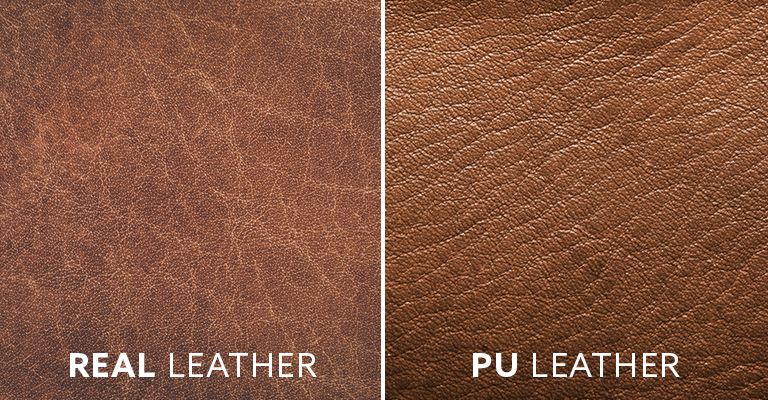
What is PU leather?
PU leather is a fabric base, often polyester or cotton, coated with a layer of polyurethane. The coating is embossed with a pattern to resemble leather grain. Because it is manufactured, it is consistent: every metre looks the same, and it can be made in any colour.
PU is not automatically poor quality. Better synthetics are soft and well finished, and they have real advantages: they are lighter on cost, easy to wipe clean, and do not need conditioning. What they cannot do is breathe like a natural hide, and the surface layer can eventually crack or peel with age, particularly at the flex point.
What is real leather?
Real leather is animal hide that has been tanned. Its fibres are woven through the thickness of the hide, which is why it flexes, breathes and ages in a way plastics do not. The best grade is full-grain, covered in our plain guide to full-grain leather. Lower grades such as split leather are real but often coated, so they sit somewhere between the two worlds.
How can you tell PU from real leather?
No single test is perfect. Use several together.
Look at the edge
At a cut edge, such as inside the collar or under the insole, real leather shows a rough, fibrous texture all the way through. PU shows a smooth plastic film on top of a visible fabric backing, often with a clean line between them.
Look at the surface pattern
Real leather has natural irregularities: tiny pores, small variations, slightly different grain from one part to another. A pattern that repeats perfectly in a regular dot or crinkle is a sign of embossing, which is common on synthetics and also on corrected-grain leather.
Press it with your thumb
Real leather forms fine, soft wrinkles when pressed, which relax when you release. PU tends to stretch or form larger, flatter folds and often springs back quickly, like plastic.
Smell it
Real leather has an earthy smell. PU often smells faintly of chemicals or plastic. A very strong smell, in either case, can mean heavy coatings or glue.
Feel it in the heat
Leather warms to your hand and feels slightly breathable. Synthetic surfaces often feel cool and slick at first, and may feel clammy in a hot Indian afternoon after a few hours.
Check the price against the claim
Quality leather costs more than PU to produce. A sneaker priced very low that claims "premium leather" is worth a closer look, and so is a sneaker priced high that never names its material.
The flame test (use with care)
In a teardown, a small flame on a hidden spot can show whether a surface behaves like a hide or a plastic: leather tends to char and smell like burnt hair, while plastic tends to melt and smell of burning plastic. We use it on sacrificial pairs only, as one clue among several. Never try it on shoes you plan to wear. Our guide to how we score sneakers explains where it fits in a teardown.
Which labels mean what?
- Leather / genuine leather: real hide, of unstated grade.
- Full-grain, top-grain: real hide, with the grade named.
- Nappa: a soft, smooth leather type. See our suede, nubuck and Nappa guide.
- PU, faux, vegan, synthetic, "leatherette": man-made.
- Microfibre: a man-made material that can look and feel quite like leather, but is not a hide.
Is PU always worse than leather?
No. It depends on what you need.
| PU / synthetic | Real leather | |
|---|---|---|
| Breathability | Low | Better |
| Ageing | Can crack or peel at flex points | Creases and softens, can be conditioned |
| Care | Wipe clean | Wipe, then condition now and then |
| Price | Usually lower | Usually higher |
| Consistency | Very uniform | Natural variation |
| Rain and spills | Often wipes off easily | Needs drying and care |
If you want a budget-friendly pair for a season of casual use, a good synthetic can be a sensible choice. If you want a pair to wear for years and repair, leather is usually the better route. Our piece on premium vs budget sneakers looks at that trade-off honestly.
How do brands on Mission 91 label their materials?
We ask brands to name what they use, and we report it as they state it. For example, the product page for Gully Labs' Redeem Now Toofani Blue lists a premium synthetic leather upper, a natural rubber sole and a bamboo lycra lining. That is a clear, honest label, and it lets you decide whether it suits your use. For comparison, Unlabel's Rift names hand-painted full-grain leather. Both are valid, and the difference is why the prices differ.
The point is not that one is a villain. It is that you should know which one you are buying.
What does "vegan leather" actually mean?
"Vegan leather" simply means no animal material is used. In practice it is almost always PU or PVC on a fabric backing, though newer plant-based and recycled options exist. If an animal-free pair matters to you, "vegan" is a legitimate reason to choose synthetic. Just remember that "vegan" describes the source, not the quality or the lifespan, and a plastic coating is still a plastic coating.
A 60-second check you can do in a shop or at your door
- Turn the shoe over and look at the edge of the lining near the collar.
- Press the upper near the toe with your thumb and watch how the wrinkle forms and relaxes.
- Smell the inside of the shoe.
- Read the label under the insole or on the box. Look for words like "leather", "synthetic" or "man-made". In some markets, a small symbol indicates leather or textile.
- Compare what you found with the price and with what the brand wrote.
If three of these five point the same way, you can be fairly confident. If they conflict, ask the seller to confirm in writing. If you are buying from us and want to check a material, write to care@mission91.in.
Can a synthetic sneaker be a smart buy?
Yes, if you buy it for the right reasons. A synthetic upper makes sense when you want something easy to wipe clean, when the price needs to stay low, when you want a bold colour that leather would struggle to hold, or when you want a pair for rough use that you will not mind replacing. Where it goes wrong is when a synthetic is sold with leather language, or priced like leather. That is a labelling problem, not a material problem.
The reverse also happens. Real leather does not by itself promise quality if it is a heavily corrected split with a thick coating. That is why we encourage buyers to look past the headline word and read the full material line, the construction and the price together.
[TEARDOWN VIDEO EMBED: add when ready]
Read next: Suede vs Nubuck vs Nappa: Sneaker Leathers Explained and EVA vs Rubber Soles: What Is Under Your Sneaker?. If you are shopping, browse our top picks.
Frequently asked questions
Is PU leather real leather?
No. PU is a plastic coating on a fabric base. It can look similar to leather but it is a different material.
Is "genuine leather" better than PU?
It is real leather, which is a different material, but the label alone does not tell you the grade. Some "genuine leather" is a lower grade with a heavy coating. Look for named grades or a clear material description.
Does PU leather crack?
Over time it can, especially where the shoe bends. How quickly depends on the quality of the coating, how much you wear the pair, and how you store it.
Are PU sneakers waterproof?
Often the surface sheds water better than leather does, but that does not make the whole shoe waterproof, and seams and soles still matter. Check the product description rather than assuming.
How do I clean PU sneakers compared with leather?
PU generally wipes clean with a damp cloth and mild cleaner. Real leather also cleans with a cloth and a leather-safe cleaner, then needs time to dry and occasional conditioning. If you are unsure, test on a hidden patch first.
See the materials for yourself
Explore our leather sneakers made in India to compare named leathers, or browse Gully Labs for pairs that spell out their materials clearly.
0 comments